
Who This Visa Is For
The Thai Language ED Visa is designed for foreign nationals who wish to study Thai language at an accredited school in Chiang Mai. This visa is suitable for anyone seeking legitimate long-term residence with visa security while developing Thai language proficiency.
You do not need prior Thai language knowledge to enroll. Courses are structured from beginner through advanced levels. The visa is not tied to employment. It is a pure education visa focused on serious language study.
Note: Nationals from certain countries must apply through their home country Thai embassy. Check the eligibility section for details.

Official Classification
Thai Education Visa (Non O ED Visa). Issued for study and training at accredited educational institutions approved by the Thai Ministry of Education. Thai language schools in Chiang Mai are registered with immigration authorities and operate under this classification. Initial visas are obtained from Thai embassies abroad, and extensions are processed at local immigration offices in Chiang Mai.
Course Structure and Schedule
What you will learn
Thai language curriculum covers reading, writing, listening, and speaking across multiple proficiency levels. Courses focus on practical communication, Thai script, grammar, vocabulary, and cultural context. Programs range from beginner (absolute zero knowledge) through advanced fluency.
Class schedule
- Hours per week: 4 hours per week minimum, plus homework and self-study
- Duration: 1–3 hour classes per session
- Frequency: Monday–Friday classes
- Levels: Beginner, Elementary, Intermediate, Advanced available
- Format: Online, in-person, or hybrid options available at most schools
- Group or private: Both group and private tuition options available
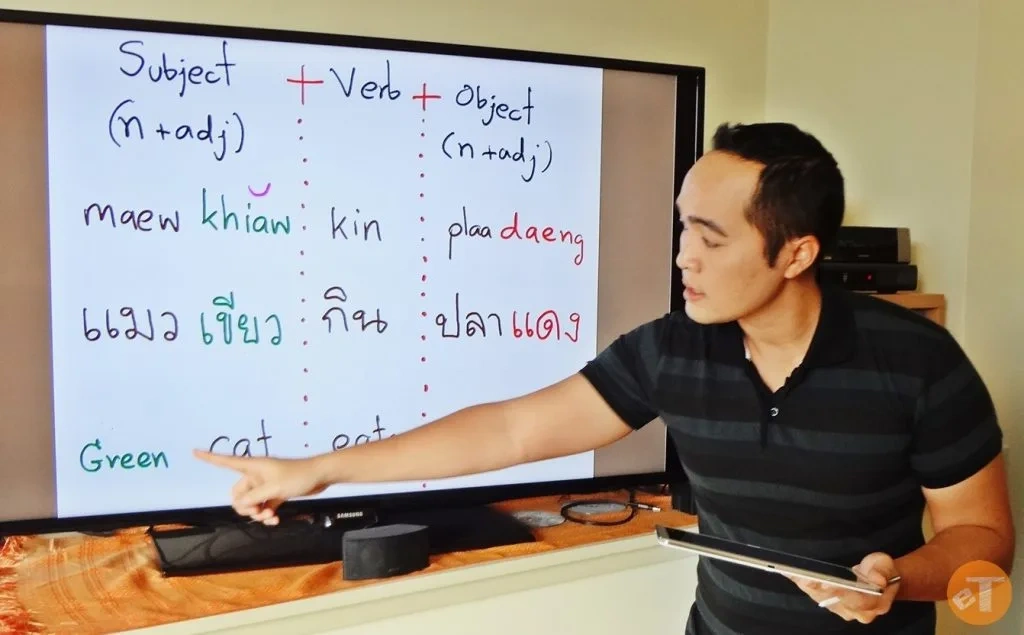
Who attends
Classes are mixed-nationality and mixed-age. You will study alongside other foreign nationals seeking Thai fluency. Classes are designed to accommodate absolute beginners through intermediate learners. Teachers are native Thai speakers with experience teaching foreigners.
A Typical Thai Language Study Day
Daily breakdown (example of 15–20 hours/week)
- Morning class (1–1.5 hours): Grammar, reading, writing. Textbook-based instruction with exercises.
- Break (15–30 minutes): Rest and refreshment.
- Afternoon class (1–1.5 hours): Listening and speaking practice. Conversation, pronunciation, vocabulary.
- Optional evening session (varies): Some programs offer optional extra classes for advanced students or specialized topics.
First-day experience
New students complete a placement assessment to determine starting level. You will meet the instructors and other students. Assessment typically takes 30–60 minutes and covers reading, writing, listening, and speaking basics. No previous knowledge required.

Progress and advancement
Most programs include regular progress assessments (monthly or quarterly). You advance to higher levels upon demonstrating competency. Classes emphasize practical communication over test performance. Regular homework and self-study expectations vary by program.
Visa Validity and Extensions
| Feature | Detail |
|---|---|
| Initial visa (from abroad) | 90 days (single entry) |
| Initial visa (in-country) | 90 days (if eligible for tourist visa conversion) |
| Extensions at Immigration | 90-day intervals (must renew in person every 90 days) |
| Maximum total duration | Typically 6–12 months depending on course enrollment |
| Processing time (initial) | 8–14 weeks total (Chiang Mai) |
| Re-entry permit | Required before international travel; Single: 1,000 THB (valid for visa period) |
The ED Visa for Thai language is issued for 90 days from abroad or via in-country conversion. You must renew (extend) your visa every 90 days in person at Chiang Mai Immigration. The school handles documentation; you attend the appointment. Each extension allows another 90 days of study and residence. If you plan to leave Thailand, obtain a re-entry permit before departure to preserve your visa.
Financial Requirements
| Duration | Cost – From Abroad (THB) | Cost – In Thailand (THB) |
|---|---|---|
| 3 months (Thai) | 14,000–19,800 | 31,000–36,800 |
| 6 months (Thai) | 21,900–32,800 | 38,900–49,800 |
| 9 months (Thai) | 35,900–42,800 | 41,900–59,800 |
| 12 months (Thai) | 38,900–49,800 | 53,900–66,800 |
| Dependent visa (spouse) | 20,000 THB (extension fees separate) | |
Costs shown are school enrollment and course fees. Prices vary by school and course level (group vs. private). All fees exclude Thai embassy visa application fees (typically 80 USD / 2,000 THB) and immigration extension fees (1,900 THB per 90-day extension).
Budget 15,000–25,000 THB per month for comfortable living in Chiang Mai, depending on accommodation and lifestyle choices.
Required Documents and Application Timeline
What to submit
Submit these documents electronically or in-person during your appointment:
- Valid passport (at least 6 months validity)
- Two passport photographs (4×6 cm, blue background standard)
- Completed application form with personal and visa history
- Evidence of living resources (bank statements, income documentation)
- Current visa/immigration stamp (if already in Thailand)
Application timeline
- Contact & inquiry: 1–3 days (response time)
- Complete application form: 1–2 days (can be done remotely)
- School processing & documentation: 1–2 days
- Ministry of Education processing: 6–8 weeks (Chiang Mai; longer than Bangkok/Pattaya branches)
- Thai E-Visa online processing: 1–4 weeks via official Thai E-Visa website (thaievisa.go.th)
- Total end-to-end: 8–14 weeks from initial contact to visa in hand (Chiang Mai)
Application Process: Step by Step
Two main pathways exist: (1) Apply from abroad via Thai embassy or online E-Visa system, or (2) Convert from tourist visa if already in Thailand (specific conditions apply). The standard path is applying from abroad.
Applying from abroad (most common)
- Contact the school via email, Facebook, or phone. Request course information, pricing, visa timeline, and enrollment requirements.
- Complete enrollment form remotely. Provide personal details, passport information, visa history, and language learning goals. Submit required documents: passport scan (all pages including visa stamps), passport photo (white background, formal attire, clearly showing both ears), and bank statements.
- School processes your documentation. The school verifies documents and generates the official "Letter of Invitation" and supporting paperwork required by Ministry of Education (1–2 days).
- School submits to Ministry of Education. The school forwards your complete application to Thailand's Ministry of Education for ED Visa approval. This process takes 6–8 weeks in Chiang Mai (longer than Bangkok/Pattaya branches).
- Receive Ministry approval. Once approved, the school notifies you and provides the final documentation package for visa application.
- Apply via online E-Visa system. Visit the official Thai E-Visa website (thaievisa.go.th) and submit your application online with school documents and passport information. Online processing typically takes 1–4 weeks. No embassy visit required.
- Receive ED Visa approval & pay fees. Once approved online, arrange payment of visa fees (typically 80 USD / 2,000 THB) and collect your passport with ED Visa stamp.
- Enter Thailand. Arrive in Thailand with your 90-day ED Visa. Contact the school to confirm class schedule, payment arrangements, and first day of study.
- Every 90 days: You must renew your visa in person at Chiang Mai Immigration. The school arranges appointments, provides documentation, and attends with you. You must be present for each renewal. Immigration grants a new 90-day extension each time.
In-country conversion (tourist visa holders)
If you are already in Thailand on a tourist visa and meet specific conditions, some schools offer conversion to ED Visa without leaving the country. Contact the school directly to confirm eligibility and specific requirements for your location.
Travel and Attendance Requirements
Thai language study requires consistent attendance. Schools typically mandate 80% attendance minimum to maintain visa compliance. You must attend class regularly throughout your stay. Excessive absences may jeopardize your 90-day visa extension.
Travel during your visa
Domestic travel within Thailand requires no permission. However, if you plan to leave Thailand and return, you must obtain a Single Re-Entry Permit (1,000 THB) before departure. This permit preserves your ED Visa during absence. Without it, your visa terminates and you forfeit course refund.
The re-entry permit is valid for your current 90-day extension period. You must return to Thailand before your visa expires to renew it in person. Prolonged absences affect course progress and attendance requirements.
When re-entering Thailand, be prepared to present your certificate of student status and answer questions about your school, course, instructor, and classmates. Immigration may test your Thai language proficiency even if enrolled in an English course.
Chiang Mai Application and Immigration Notes
Chiang Mai Immigration (Mae Rim, 30 minutes from Old City) handles ED Visa extensions. The school attends extension appointments with you. The process is straightforward and quick, though wait times vary. The school handles all documentation and scheduling; your role is to attend the appointment with the school and provide updated living resources documentation if requested.
Thai language schools are centrally located in Chiang Mai, typically in the Nimman area or near the Old City. Many students live within walking or short Grab distance for convenience.
Eligibility and Country Restrictions
Most nationalities can apply for an ED Visa for Thai language study. However, nationals of the following countries must apply through their home country Thai embassy rather than within Thailand:
Andorra, Bhutan, Bulgaria, China, Cyprus, Ethiopia, Fiji, India, Kazakhstan, Latvia, Lithuania, Maldives, Malta, Mauritius, Papua New Guinea, Romania, San Marino, Saudi Arabia, Taiwan, Ukraine, Uzbekistan.
If you are a national of one of these countries, you must apply from your home country embassy. Confirm with the school if you are unsure about your country's requirements.
Benefits of the Thai Language ED Visa
- Legal, secure long-term residence in Thailand (3 months initially, extendable up to 12 months).
- Peace of mind with Thai immigration authorities.
- 90-day reporting: Required every 90 days. File form TM.47 at Chiang Mai Immigration between 14 days before and 7 days after your deadline to avoid 2,000 THB fine. Easy process; typically 5–10 minutes online or in-person.
- Eligibility for Thai driver's license (car and motorcycle).
- Ability to open Thai bank accounts and obtain Thai credit cards.
- Government attraction discounts and vehicle purchase/sale rights.
- Post-paid mobile phone contract eligibility.
- Single or Multiple re-entry permits for international travel.
- Spouse can obtain Non-O (dependent) visa on your ED Visa status.
- Genuine language skills that improve daily life and employment prospects in Thailand.
- Access to a diverse, multinational study community.
Why Choose Thai Language Over Other ED Visas?
Thai language study offers distinct advantages:
- Practical life skill: Speaking Thai immediately improves daily interaction, cost of living, and integration in Thailand.
- Employment pathway: Thai language opens opportunities in teaching, translation, business, and local employment.
- Structured program: Multiple schools, levels, and flexible scheduling allow customized learning paths.
- Cultural integration: Language study deepens cultural understanding and connection to Thailand.
- Community: Thai language students form strong friendships and professional networks in Chiang Mai.
- Cost effective: Language study programs are among the most affordable ED visa options.
Common Questions
Standard programs require 4 hours per week of classroom instruction, plus homework and self-study assignments. Class schedules are flexible, typically Monday–Friday during daytime hours. Schools offer both group classes and private tuition. Total commitment varies based on course intensity and your self-study effort.
No. Programs accept absolute beginners. You will be placed in a class appropriate to your level (beginner, elementary, intermediate, advanced). A placement assessment on your first day determines your starting level.
Yes. You do not need special permission for domestic travel. If you leave Thailand, you must obtain a Single Re-Entry Permit (1,000 THB) before departure to preserve your extension. This permit is valid for 3 months (your current extension). Travel gaps longer than 30 days may cause compliance issues. Extended absence may affect attendance requirements.
Initial visa is 90 days. You must renew your visa in person at Chiang Mai Immigration every 90 days. Each renewal grants another 90 days. Total duration depends on your course length. A 6-month course requires 2 visa renewals; a 12-month course requires 4 renewals. After completing your course, you can reapply for a new program and continue studying for multiple years.
Nationals of specific countries (China, India, Middle East, Eastern Europe, etc.) must apply through their home country Thai embassy rather than within Thailand. This does not prevent you from obtaining the visa; it simply requires applying from abroad. Confirm with the school or CMLocals if your country is affected.
Married spouses can obtain a Non-O (dependent) visa valid while you hold your ED Visa. Cost is approximately 20,000 THB. Partners not married cannot use this route. Consult your local Thai embassy about dependent visa requirements and documentation.
Yes. Schools require 80% minimum attendance for visa extension eligibility. Immigration requires evidence of ongoing education participation. Excessive absences may jeopardize your 90-day visa renewal. You must attend renewals in person every 90 days. Inform your school well in advance about any planned extended absences.
Disclaimer – General Thai Visa Advice Only
This page provides general information about the Thai ED Visa for Thai language study based on current policy and first-hand experience. It is not official immigration advice, and visa requirements, procedures, and fees vary by embassy, immigration office, and individual circumstance.
Immigration law and regulations change frequently. Always verify current requirements with the school, your nearest Thai embassy, and local immigration office (Chiang Mai Immigration). This information is current as of the date below; check official sources for updates.
For specific legal or immigration advice, consult a qualified Thai immigration lawyer or your embassy.