
Who This Visa Is For
The Education Visa (ED Visa) for Muay Thai training is designed for foreign nationals who wish to study combat sport at an accredited training facility in Thailand for a defined period. It is suitable for fitness enthusiasts, competitive fighters, career trainers, and anyone seeking legitimate long-term training access with visa security.
This visa is not tied to employment. It is a pure education/training visa. You are not required to work, and training time is flexible within the two main tiers (Fun & Fitness or Professional).
Note: Nationals from India, China, and countries in the Middle East must apply through their home country Thai embassy rather than within Thailand.

Official Classification
Thai Education Visa (ED Visa), Class A. Issued for study and training at accredited educational institutions approved by the Thai Ministry of Education. The Muay Thai program is registered with immigration authorities and operates under this classification. The visa is administered by Immigration Bureau and Thai embassies.
Initial visas are obtained abroad from Thai embassies or consulates. Extensions of stay are processed at local immigration offices in Thailand (e.g., Chiang Mai Immigration).
Training System: Five Modules
The program is structured in five progressive modules, allowing entry at any level based on prior experience:
- Beginner Muay Thai: Foundational techniques, stance, basic strikes, and movement. No experience required.
- Intermediate Muay Thai: Combinations, pad work, clinch technique, and tactical understanding. Requires foundational fitness and basic technique.
- Advanced Muay Thai: Ring sparring preparation, advanced combinations, footwork patterns, and competitive technique. For practitioners with solid intermediate skills.
- Trainer Certificate (6 months): Coaching fundamentals, exercise programming, class leading, and business practices. Graduates can work as trainers domestically or internationally.
- Referee Certificate (6 months): Rules interpretation, fight management, scoring protocols, and ring procedures. Graduates can referee amateur and professional bouts.

Two Training Tiers: Fun & Fitness vs. Professional
Training is offered in two tiers. Choose the duration (6 or 12 months) based on your goals. Your ED Visa will be 3 months initial + three 3-month extensions (12 months max), regardless of your training package length. If you purchase a 6-month training package, you will have 6 months of funded training within a 12-month visa window.
Tier 1: Fun & Fitness
Designed for hobbyists, fitness practitioners, and part-time trainees. Requires a minimum of 2 classes per week. You may attend more frequently, and flexibility is built in for travel and rest days.
Training package cost:
| Training Duration | Classes Included | Total Cost (THB) | Cost Per Class |
|---|---|---|---|
| 6 months | 60 classes | 33,900 | 565 THB |
| 6 months | 90 classes | 41,900 | 466 THB |
| 12 months | 90 classes | 53,700 | 597 THB |
| 12 months | 120 classes | 63,700 | 531 THB |
All costs include upfront enrollment, immigration processing fees, and any required 3-month extension fees at immigration. You own the schedule flexibility. Note: Your visa is always valid for 12 months max (3-month initial + three 3-month extensions), so a 6-month package leaves 6 months of visa remaining for additional training or other activities.
Tier 2: Professional
Unlimited classes. Intended for serious practitioners, aspiring fighters, career trainers, and those pursuing competition. You may attend daily if desired and can compete in amateur or professional bouts.
Training package cost:
| Training Duration | Class Access | Total Cost (THB) |
|---|---|---|
| 6 months | Unlimited | 51,900 |
| 12 months | Unlimited | 83,700 |
Professional tier covers all competition fees, coaching support, and training accommodations within the pricing. You can earn from fights and coaching work while on the visa. Your ED Visa is valid for 12 months regardless of training duration, so plan your training package accordingly.
Visa Validity and Extensions
All ED Visas follow the same standard structure regardless of training duration or tier:
| Feature | Detail |
|---|---|
| Initial visa (from abroad) | 3 months (single entry) |
| In-country changeover | Possible in Chiang Mai if circumstances and timing allow (rare; confirm with school) |
| Extensions at Immigration | Three consecutive 3-month extensions (total: 3 + 9 = 12 months max) |
| Permitted stay on entry | 90 days initially |
| Extension processing | 1–8+ hours at local immigration (Chiang Mai) |
| Re-entry permit (Single) | 1,000 THB if leaving Thailand during visa/extension period. Valid for 3 months (length of current extension). |
| Re-entry permit (Multiple) | 3,800 THB (not recommended). Still only valid per extension period (3 months). |
| Maximum total duration | 12 months (3-month initial + three 3-month extensions) |
| Beyond 12 months | Requires reapplication from abroad or transition to a different visa category |
The ED Visa structure is rigid: all categories receive the same 3-month initial visa and three 3-month extensions regardless of your training program length. Plan your training duration (6 or 12 months) within this 12-month maximum window. If you need longer than 12 months of training, you must reapply after your current visa expires.
Financial Requirements
All upfront costs are included in the pricing tables above. These cover:
- School enrollment and training access
- Immigration processing and documentation fees
- 3-month extension processing (if extended within Thailand)
- Any required school letters and immunisation records
You are responsible for living expenses (accommodation, food, utilities), which are not included. Budget 15,000–25,000 THB per month for comfortable living in Chiang Mai, depending on accommodation choice.
Required Documents for Application
Submit these documents electronically to the school during your remote application. Requirements may vary by school and Thai embassy; confirm specifics with the school before applying.
- Valid passport with at least 6 months validity (scan or photo)
- Passport photographs (standard size, 4×6 cm, digital copy acceptable)
- Completed application form with personal details and visa history
- Bank statements showing financial capacity (recent 3–6 months)
- Current visa/stamp information (if already in Thailand)
- Medical documentation or health declaration (varies by school)
- Evidence of prior Muay Thai experience (if entering at intermediate/advanced level)
Application timeline
- Contact & inquiry: 1–3 days (response time)
- Complete application form: 1–2 days (can be completed remotely)
- School processing & documentation: 1–2 days
- Ministry of Education processing: 6–8 weeks (for school's ED Visa approval)
- Thai embassy/eVisa system: 3–10 days (if all documents correct)
- Total end-to-end: 8–12 weeks from initial contact to visa in hand
Application Process: Step by Step
The standard path is to apply from abroad at a Thai embassy. In rare cases, if timing and circumstances align, an in-country changeover in Chiang Mai may be possible; confirm with the school whether this applies to your situation.
- Contact the school via Facebook Messenger, email, or WhatsApp. Introduce yourself, ask about available modules and visa timelines. Ask if in-country changeover is an option for your circumstances.
- Complete the application form remotely. The school provides a form requesting personal details, passport information, visa history, and training preferences. Submit completed form and required documents (passport scan, bank statements, etc.) electronically.
- School processes your documentation. The school verifies your documents and generates the official "Letter of Invitation" and supporting paperwork for visa issuance (1–2 days).
- School submits to Ministry of Education. The school forwards your application to Thailand's Ministry of Education for ED Visa approval. This process takes 6–8 weeks.
- Receive Ministry approval & school confirmation. Once approved, the school notifies you and provides the final documentation package for embassy submission.
- Apply at Thai embassy (or eVisa). Submit your application to the nearest Thai embassy or consulate with school documents, passport, and completed visa application forms. Some embassies accept online eVisa applications. Pay visa fees (typically 80 USD / 2,000 THB or local currency equivalent).
- Await embassy/eVisa processing. Processing typically takes 3–10 days if all documents are correct. Some embassies may take longer depending on workload.
- Receive ED Visa (3-month initial). Collect your passport with ED Visa stamp (or receive confirmation for eVisa). This initial visa allows 3 months of permitted stay.
- Enter Thailand and begin training. Training starts immediately. Contact the school to arrange class schedule and payment.
- First 3-month extension: Within the 3-month window, visit local immigration (Chiang Mai) with school documents (letter of continuation, fee receipt). Bring TM.7 form, passport copy, and completed form provided by immigration. Receive your first 3-month extension.
- Second 3-month extension: Three months after the first extension, repeat the process at immigration for your second 3-month extension.
- Third 3-month extension: Three months after the second extension, repeat the process at immigration for your final 3-month extension. Total visa duration: 3 (initial) + 3 + 3 + 3 (extensions) = 12 months maximum.
All ED Visas are limited to 12 months maximum (3-month initial + three 3-month extensions). Plan your training and future visa strategy accordingly. Do not assume the visa will be extended beyond the third extension.
A Typical Muay Thai Training Session
Understanding what to expect during a training session helps you assess the commitment and structure of the program.
Class structure (60–90 minutes)
- Warm-up (5–10 min): Jump rope, light jogging, dynamic stretches, joint mobility exercises.
- Technique drill (10–15 min): Controlled practice of specific strikes (jab, cross, kick, elbow, knee) on pads or in shadow form. Focus on posture and precision.
- Pad work (20–30 min): Partner holds pads (Muay Thai focus pads). Trainee executes combinations at varying intensity. Trainer calls combinations and provides real-time feedback.
- Heavy bag (10–15 min): Solo practice on the heavy bag. Builds power and timing. Usually done at self-determined intensity.
- Conditioning (10–15 min): Core work, burpees, push-ups, leg exercises. Muay Thai is demanding; conditioning is integral.
- Cool-down & stretching (5–10 min): Static stretches, breathing exercises, cool-down walk.
Beginner class atmosphere
Beginner classes are mixed-ability and supportive. Trainers provide individual attention. You work at your own pace. No competition. Common modifications are offered for fitness level variations.
Intermediate/Advanced class atmosphere
Faster pace. Higher intensity. More focus on precision and power. Sparring may be introduced at advanced level. Trainers expect prior familiarity with terminology and basic footwork.
Training attire and etiquette
- Wear shorts and a t-shirt or tank top (loose, breathable materials).
- Bring hand wraps and 8–10 oz boxing gloves (school can provide or recommend suppliers).
- Remove shoes upon entering the gym. Respect the training space as a sacred arena.
- Always wai (bow with hands together) to the trainer before and after class.
- Ask permission before handling equipment or heavy bags.
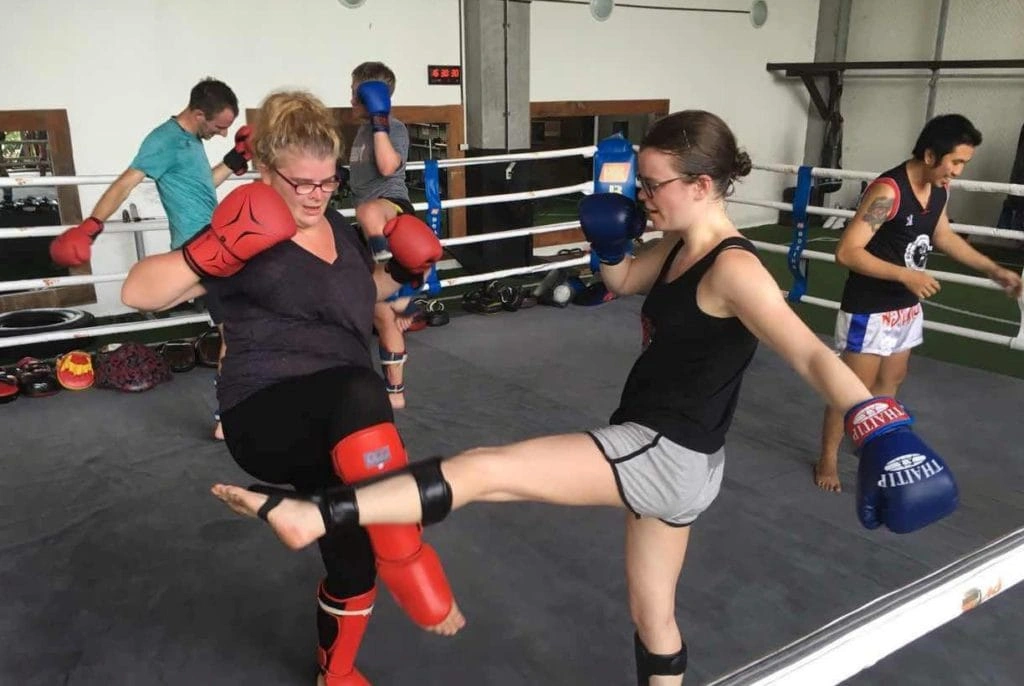
Intensity and physical demands
Muay Thai is a full-body workout. Expect elevated heart rate, sweating, and muscle soreness (especially days 1–7). Recovery is normal. Trainers modify exercises for fitness level. It is not required to be fit before starting; fitness builds during training.
The Fun & Fitness tier allows rest days and flexible scheduling. You control frequency. The Professional tier assumes consistent, intense commitment.
Travel and Attendance Requirements
Travel during ED visas is generally discouraged. Immigration regulations require continuous attendance throughout your study period. However, Muay Thai training differs from other ED Visa programs in one crucial way: the flexibility of class scheduling.
How Muay Thai flexibility works
Unlike Thai language or university ED visas with rigid class schedules, Muay Thai offers session-based training. Your 60 or 90 classes can be used flexibly:
- Compressed schedule: 30 sessions in one month, then 2 months off (example: intensive month + travel).
- Spread schedule: 2 sessions per week consistently across your 6 or 12-month period.
- Mixed: Any variation that suits your life, as long as your class count progresses within your enrollment period.
If you need to travel
Consult the school as soon as you know travel is necessary. Most schools can accommodate flexible scheduling to allow short trips. However:
- Travel gaps of more than 30 days are problematic for immigration compliance.
- You must obtain a Single Re-Entry Permit (1,000 THB) before leaving Thailand. This allows you to re-enter without losing your extension. It is valid for the length of your current extension (3 months). Multiple Re-Entry Permits (3,800 THB) are not recommended; they are still only valid per extension period and offer no advantage.
- Inform immigration of your travel plans in advance if possible.
The flexibility of Muay Thai training . especially the ability to compress or spread 60/90 sessions . is a major advantage if travel or life changes are part of your plan. Other ED Visa categories (language, university) have stricter attendance requirements and much less flexibility.

Chiang Mai Application Notes
Chiang Mai Immigration (Mae Rim, 30 minutes from the Old City) handles ED Visa extensions for residents. It is a straightforward process, though wait times can be long. Bring the school's letter of continuation, your passport, the completed TM.7 form, and copies of your documents.
The Chiang Mai training facility is centrally located (exact address provided by school upon enrollment). Many students choose to live within walking distance of the gym for convenience.
Unlike Thai language ED visas, there is no language test. No academic exams. Immigration simply verifies continued enrollment and fees are paid.
Ongoing Compliance: 90-Day Reporting & TM.30
As an ED Visa holder residing in Chiang Mai, you must comply with standard immigration obligations:
- 90-day reporting: Required every 90 days. File form TM.47 at Chiang Mai Immigration between 14 days before and 7 days after your deadline to avoid 2,000 THB fine. Easy process; typically 5–10 minutes online or in-person.
- TM.30 notification: Your accommodation owner/landlord must register you within 24 hours of your arrival. Usually handled by the landlord automatically. Bring copy to your records.
- Attendance and study compliance: Immigration requires continuous participation in your training program. Muay Thai offers flexibility in scheduling, so you can condense or spread your sessions within your enrollment period.
Benefits of the Muay Thai ED Visa
- Legal, secure long-term residence in Thailand (up to 12 months initially, with possibility of reapplication).
- Peace of mind with Thai immigration authorities.
- Eligibility for Thai government discounts (parks, attractions, transport).
- Ability to open Thai bank accounts and obtain Thai credit cards.
- Eligibility for Thai driver's license (car and motorcycle).
- Flexibility in training schedule (Fun & Fitness tier) with part-time commitment.
- Professional advancement (Trainer or Referee certificates can lead to employment in fitness or sports industries).
- Professional tier allows legal competition and earning from fights.
- Spouse can obtain Non-O (dependent) visa on your ED Visa status.
- Access to a supportive training community and international peers.

Common Questions
No. The Beginner module is designed for absolute newcomers. However, if you have prior training, you can enter at Intermediate or Advanced level, which accelerates progression and may reduce total visa duration cost.
Yes, but you must obtain a Single or Multiple Entry Re-Entry Permit before leaving. Without it, your extension is cancelled upon departure. The permit costs ~1,000 THB and is obtained at immigration before travel. Multiple Entry permits are recommended for frequent travelers and cost ~3,800 THB.
Yes. The ED Visa is issued for study at a specific accredited school. Changing schools requires a new visa process. You cannot simply transfer enrollment and continue on the same visa. If you wish to change training providers, consult with immigration about your options.
The ED Visa does not authorise employment for Thai entities. However, the Professional tier allows earning from Muay Thai activities (competition, coaching for the school, event work). For unrelated employment (teaching, IT, etc.), you would need a separate work permit, which is complicated on an ED Visa background. Seek legal advice if employment is part of your plan.
All ED Visas allow a maximum of 12 months (3-month initial + three 3-month extensions). After your third extension expires, you must either reapply for a new ED Visa from abroad, switch to a different visa category (Volunteer, Tourist, LTR, or Non-Immigrant B), or leave Thailand. Do not wait until the final week to plan your next step. Contact the school or immigration office 4–8 weeks before your final extension expires to discuss options.
Living costs vary. A comfortable lifestyle (rented room, meals, utilities, transport) costs 15,000–25,000 THB per month. Budget-conscious living is possible at 10,000–15,000 THB. Luxury living (private apartment, dining out, activities) is 25,000+ THB. Your visa cost does not include living expenses.
Travel during ED Visas is discouraged because immigration requires continuous attendance. However, Muay Thai offers unique flexibility: your 60 or 90 sessions can be scheduled flexibly (e.g., 30 sessions in one month, then 2 months off). If you plan to travel, consult the school immediately. You must obtain a Single Re-Entry Permit (1,000 THB) before leaving Thailand to preserve your extension. This permit is valid for 3 months (your current extension period). Multiple Re-Entry Permits (3,800 THB) are not recommended and offer no advantage. Inform immigration of travel plans in advance if possible. Travel gaps longer than 30 days may cause compliance issues.
Married spouses can obtain a Non-O (dependent) visa, which is valid as long as you hold your ED Visa. Partners not married cannot use this route. Consult your local Thai embassy about dependent visa requirements and required documentation.
Disclaimer – General Thai Visa Advice Only
This page provides general information about the Thai ED Visa for Muay Thai training based on current policy and first-hand experience. It is not official immigration advice, and visa requirements, procedures, and fees vary by embassy, immigration office, and individual circumstance.
Immigration law and regulations change frequently. Always verify current requirements with the school, your nearest Thai embassy, and local immigration office (Chiang Mai Immigration). This information is current as of the date below; check official sources for updates.
For specific legal or immigration advice, consult a qualified Thai immigration lawyer or your embassy.